
Updated November 6, 2026
The short answer: this free helper walks you through an emotional flashback one small step at a time. You name it, breathe with a calm circle, remind yourself you’re safe and an adult now, notice what’s around you and answer the harsh inner voice. It takes about 3 minutes, and nothing you tap or type is saved.
When an old wave of fear, shame or panic rushes in, it can be hard to remember what helps. Thinking feels foggy and everything feels urgent.
So you don’t have to remember anything. Just press Start and follow along. Go at your own pace, skip any step and come back as often as you need.
Come back to now
A sudden wave of old fear or shame?
Let’s come back to now together, one small step at a time. It takes about 3 minutes. Go at your own pace and skip anything you like.
How strong is the feeling right now?
Step 1 · Name it
This might be a flashback.
Old feelings can rush in when something small touches an old hurt. Naming it can bring a little space.
Say it softly, out loud or in your head:
“I’m having a flashback.
These feelings are from the past.”
Step 2 · Breathe with the circle
Breathe in as it grows.
Breathe out as it shrinks.
The out-breath is a little longer. That helps your body settle.
Step 3 · You’re safe now
Your body is reacting to old danger.
Right now, in this moment, you can tell it:
“I feel afraid, but I’m not in danger.
I’m safe right now.”
Step 4 · You’re an adult now
The feelings are old. You are here, today.
Today is
today
Look at your hands. They are grown-up hands now. You have choices, skills and a voice you didn’t have as a child.
Step 5 · Feet on the floor
Name 5 things you can see.
Tap a circle for each one. A lamp, a cup, the colour of the wall. Anything counts.
Step 6 · Be kind to the younger you
Put a hand on your heart.
Part of you may feel very young right now. Speak to that part the way a loving grown-up would:
“You’re safe with me.
I’m here now.”
Step 7 · Answer the old voice
Is a harsh voice saying something?
Tap the one that sounds closest.
“That’s an old voice. I’m doing my best.”
Step 8 · It will pass
Flashbacks feel endless, but they always end.
This one will too. Take one more slow breath, a little longer on the way out.
How strong is the feeling now?
You came back to now
One kind thing you can do next
Pick whatever feels good.
Well done
You stayed with yourself through a hard moment.
That’s a real skill, and it grows every time you practise it.
Later, when you feel calmer: what set it off? A few words can help you spot patterns over time.
Nothing you type here is saved or sent anywhere.
Based on the work of Pete Walker, simplified. ·
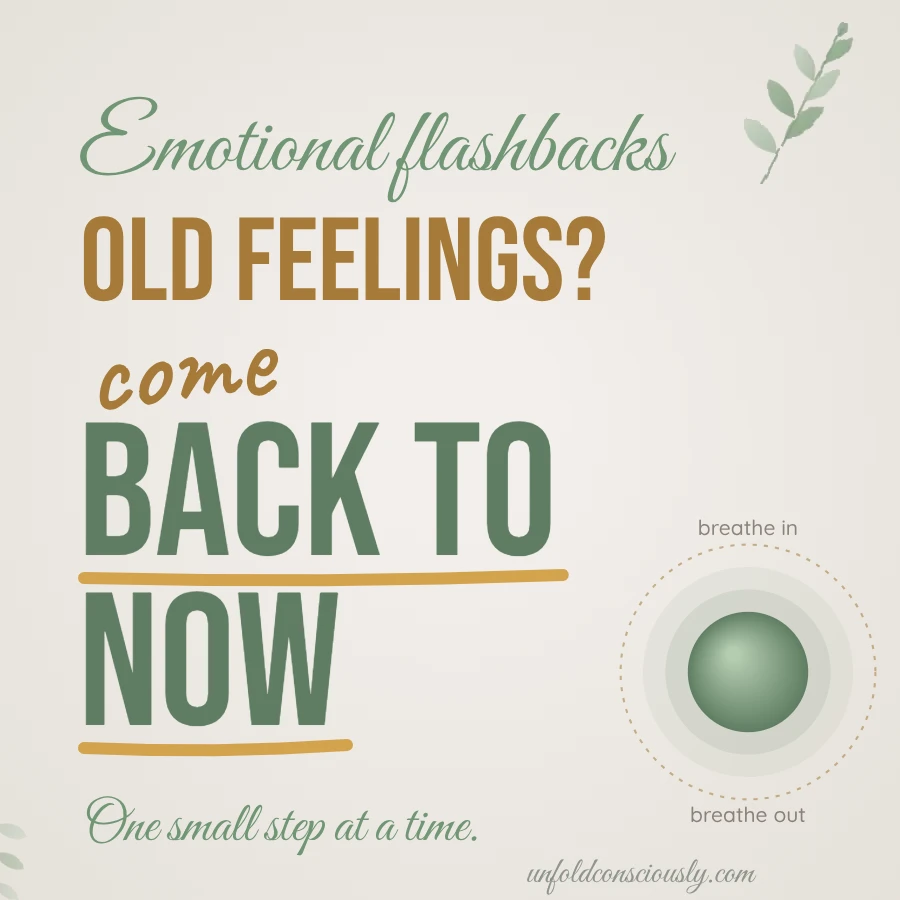
How to Use This Helper
- Keep it close. Bookmark this page or add it to your phone’s home screen, so it’s one tap away in a hard moment.
- Use it as often as you like. Some days once is enough. Other days you may want to go through it twice.
- Practise on a calm day. Trying it when you feel okay helps your body learn the steps, so they come more easily when you need them.
Why These Steps Help
The steps are based on therapist Pete Walker’s well-known steps for managing flashbacks, from his book Complex PTSD: From Surviving to Thriving, made shorter and simpler. Naming the flashback, slowing your breath and noticing the room around you all help your body see that the old danger isn’t happening now.
To learn more about what flashbacks are and why they happen, read our guide to emotional flashbacks: signs, examples and how to cope.
Related guides: Hypervigilance · Freeze and fawn responses · How to get out of dissociation
Back to CPTSD: understanding complex trauma
Your unfolding is already underway, and it's beautiful.