
Updated November 3, 2026
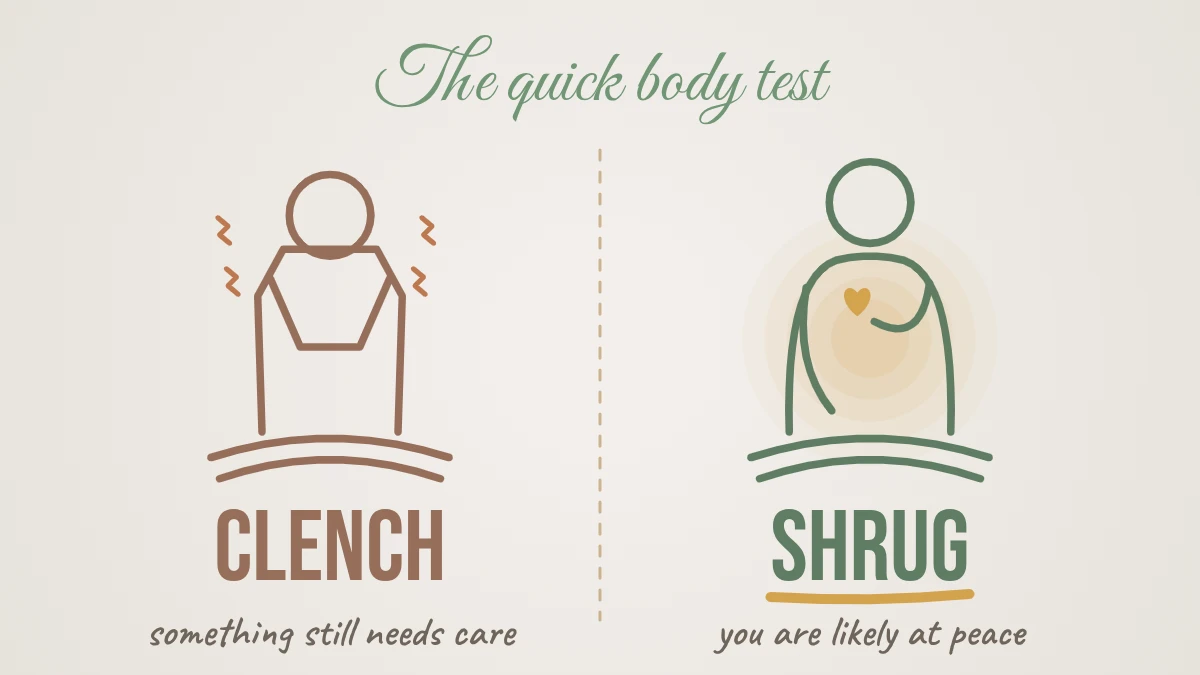
The short answer: signs you are suppressing emotions include tension in your body (jaw, belly or shoulders), replaying the moment or rehearsing what you’d say, resentment that leaks out later, and avoiding a person or place. When you’re genuinely at peace, your body feels relaxed, you feel curious rather than stuck in a story, and you can say hello and move on. A quick test: picture it happening again tomorrow and notice whether your body clenches or shrugs.
If something happened that “should” have upset you, and it didn’t, you might be wondering if something is off. Are you really okay, or are you just very good at pushing feelings down?
That’s a fair question, especially if you’ve spent years holding things in, or ignoring and denying them entirely, to keep the peace. Here’s how to tell the difference, starting with a small story from my own week.
The morning the music started at 6:20
A few days ago, I woke at 6:20am to loud music from my neighbour’s flat. He had two friends over, and they had been up all night. Later they moved to the shared pool and kept the music going into the afternoon.
A few days earlier, the same neighbour had been very considerate. He apologised for any noise from a leaving party (I hadn’t heard a thing) and told me he rolls his scooter down the road before starting it, so he won’t wake anyone before 6am.
When I came back that morning from some time at a café, the group was by the pool. He didn’t mention the music. I said hello and kept walking.
My first thought was: “It’s just a bit weird.” I wasn’t upset, more surprised. His kind words and the 6:20am music didn’t match.
Then I asked myself: “If this happened every morning, would I be bothered?” The honest answer was no, not really. When I pictured the music starting again at 6:20am the next day, my first thought was, “Oh cool, I get to start my day.” I love mornings. It’s ridiculous, but ridiculous in an amazing way.
Part of me found that strange. Most people would be upset at being woken like that. So I checked: am I really fine, or am I suppressing it?
The “This is fine” meme, and what suppression looks like
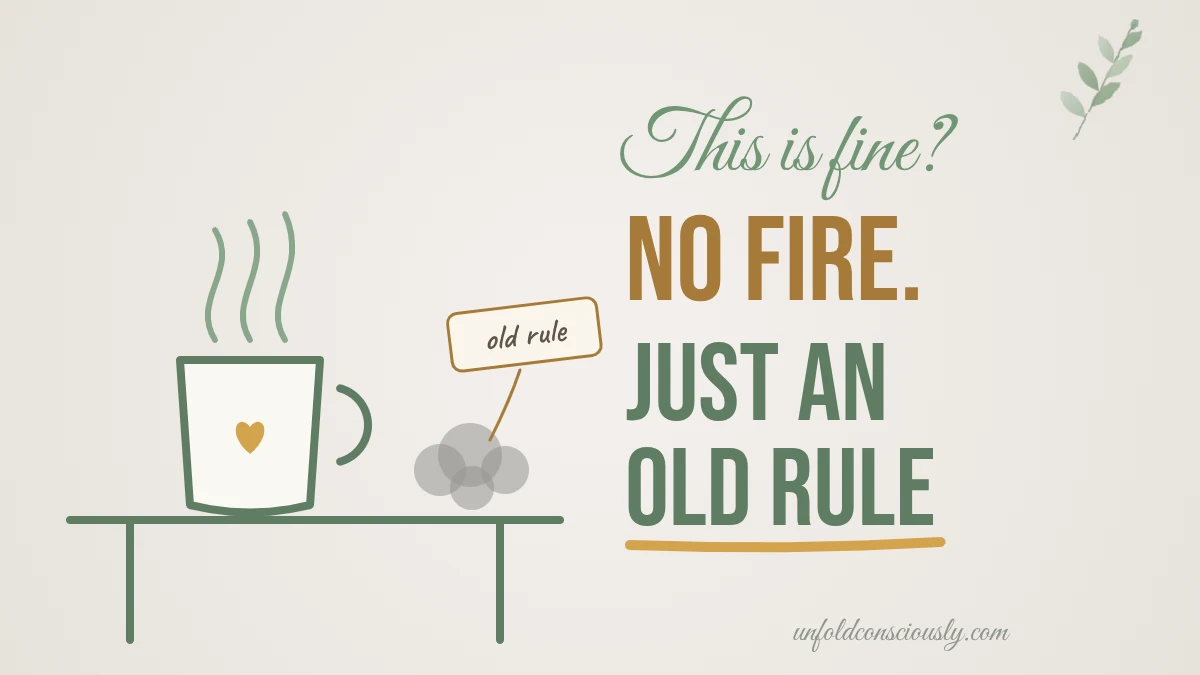
You’ve probably seen the “This is fine” cartoon by artist KC Green: a dog sits calmly at a table, sipping coffee, while the room around him is on fire.
It’s funny because we all know that feeling. Something hurts or scares us, and we smile and say “I’m fine” while the fire spreads. That’s suppression: pushing a feeling down so you don’t have to feel it.
Suppression often starts as a way to stay safe. If showing anger or sadness wasn’t welcome when you were growing up, holding it in made sense. But feelings that get pushed down don’t disappear. Research by psychologists James Gross and Oliver John found that people who often hide their feelings tend to feel more negative emotions overall and less close to others.
Sometimes, though, there really is no fire. There’s just an old rule sounding the alarm. That’s what my 6:20 morning turned out to be.
Signs you’re suppressing emotions vs signs you’re at peace
Signs you might be suppressing:
- Tension in your body: your jaw, belly or shoulders tighten, or your whole body feels braced.
- A story on repeat: you replay what happened, or rehearse what you’d say to them.
- It leaks out later: resentment shows up days later, or you feel tired for no clear reason.
- Avoiding: you go out of your way to avoid the person or place, even avoiding looking at them.
Signs you’re genuinely at peace:
- Your body feels relaxed: your breathing is easy and your shoulders are soft.
- Curiosity: you wonder about it instead of looping through the same story.
- You can enjoy what’s here: for me that day it was the rain, my food and a show.
- You can say hello easily and move on with your day.
When I checked, none of the suppressing signs were there. I know them well from my past: rehearsing conversations, whole-body tension, resentment. This time there was only a shrug. A few years ago, a hypervigilant part of me would have braced all day. That shrug told me how much has healed.
A quick body test
Try this whenever you’re unsure:
- Picture the situation happening again tomorrow, as clearly as you can.
- Slowly scan your body from your jaw down to your belly.
- Notice: is there a clench somewhere, or just a shrug?
A clench is your body telling you something still needs care. A shrug usually means you’re okay.
When it’s not fine (and that’s okay too)
Now imagine a different morning.
You’re staying in a guesthouse after a long, tiring trip. At 7am, workers start drilling in the room next door with no warning. Your body jolts awake, your heart pounds and adrenaline floods in. You sit up, wide-eyed, and can’t settle back down.
Hours later you’re still on edge. You keep replaying it, your shoulders are tight, you snap at small things, and you wonder if you should have said something to the owner.
Two mornings, two noisy wake-ups. One body shrugged, one went into alarm. Neither one is better or more healed. Context matters a lot: when you’re exhausted, somewhere unfamiliar, or have no control over your space, your body will react more strongly than it would at home.
Feeling upset is your body’s way of giving you information. It’s a normal, healthy signal.
What helps when you’re not fine:
- Meet your body first. Shake out your hands and arms, breathe out slowly a few times, and feel your feet on the floor. Let the alarm settle before you decide anything. These steps help soften fight or flight.
- Then ask: is this a rule, or a real need? In the guesthouse, it’s likely a real need: sleep and safety in your own space.
- For a real need, speak up clearly and kindly. Asking the owner for a heads-up or a later start is a healthy boundary, and it’s okay to ask.
- For a rule, question it with the steps below.
When the upset comes from a rule
When I looked closer at my “it’s a bit weird” feeling, I found a voice saying: “6:20 is a time people should not make noise.”
Is that true? Here in Vietnam, street sellers with loudspeakers start at sunrise. The rule felt inherited. I’m half German, and Germany has official quiet hours called “Ruhezeit.” I grew up with lots of rules and a strong sense of right and wrong.
Many of our upsets come from “shoulds” like these:
- “People should be quiet in the morning.”
- “Any normal person would be upset about this.”
- “It’s just common sense.”
These rules can create friction that isn’t really ours. Noticing them can be a relief. You can keep the ones that serve you and let the others go.
Question the thought
The teacher Byron Katie offers simple questions for a stressful thought. The first two are: “Is it true?” and “Can you absolutely know that it’s true?”
I tried them with a worry that popped up: “The new neighbour moving in next door means loud pool parties all the time.”
Do I know that? Absolutely not. And if it did happen, I could go out, wear my noise-cancelling headphones, or speak up if it truly bothered me.
Then I asked myself: why would I want to upset myself? I don’t. So I don’t have to.
I also noticed a clear, calm no. I didn’t want to spend time with that group, because their energy didn’t feel like a match for me. A simple hello and my own space was enough. No drama, no resentment.
Peace still includes speaking up
Being at peace doesn’t mean you never set a boundary. I stand up for myself when it matters. This just wasn’t one of those times.
If your body says “this matters,” trust it. If you notice you’re always “fine” while silently building resentment, that’s a sign to look closer, with kindness. Resistance and shame can both keep feelings hidden, and a little self-compassion helps them come out safely.
A simple practice for today
Think of one small thing that bugged you this week.
- Do the body test: picture it happening again and scan for a clench or a shrug.
- If there’s a clench, breathe out slowly three times with a hand where you feel it.
- Ask: “Is this a rule, or a real need?”
- If it’s a need, write one kind sentence you could say. If it’s a rule, ask, “Is it true?”
That’s it. A few minutes of honest checking can save you days of carrying something you don’t need to carry.
A book that may help
Links to Amazon, Audible and Bookshop.org support this site at no cost to you. As an Amazon Associate I earn from qualifying purchases.
Loving What Is by Byron Katie. The book behind the four questions, with many real examples of people questioning painful thoughts about partners, parents and daily life.
How it may help: if you often feel stuck on “they shouldn’t have done that,” it gives you a simple, step-by-step way to loosen those thoughts and feel lighter.
Prefer paper? Amazon or Bookshop.org, which supports local bookshops
Frequently asked questions
How do I know if I’m suppressing my emotions?
Look for body tension, replaying or rehearsing conversations, resentment that shows up later, unexplained tiredness, and avoiding certain people or places. If you picture the situation again and your body clenches, a feeling may still need attention.
Is it bad to not feel upset when others would?
No. People react differently, and your past, your rules and your nervous system all shape what bothers you. If your body feels relaxed and you can move on easily, you’re likely at peace.
Can suppressed feelings come out later?
Yes. Pushed-down feelings often show up later as irritability, tiredness, tension or sudden outbursts over small things. Making space for them, even for a few minutes, helps them settle.
Is acceptance the same as being a pushover?
No. Acceptance means seeing what’s happening without fighting reality in your head. You can accept that something happened and still speak up, set a boundary, or walk away.
What’s the difference between suppressing and letting go?
When you suppress, the feeling stays in your body, often as tension or a story on repeat. When you let go, your body relaxes and the thought stops pulling at you.
Related guides: Working with resistance · Healing shame · Hypervigilance
Back to Healing Emotional Patterns
Your unfolding is already underway, and it’s beautiful.